On behalf of the ISCT Mesenchymal Stromal Cell (MSC) Committee
Following administration, mesenchymal stromal cells (MSCs) rapidly encounter complex host environments that can shape their fate and function. These environments include blood components, complement and coagulation cascades, inflammatory mediators, tissue barriers, immune cells and disease-specific processes that can affect MSC biological effects, distribution, persistence and clearance. Understanding these host-cell interactions was the starting point for the ISCT MSC Committee's pre-conference workshop, 'Defining the Fate of Clinically Administered MSCs', held on 5 May 2026 during the ISCT Annual Meeting in Dublin.
The workshop also acknowledged the value of industry involvement and support, including the potential contribution of well-characterized MSC products or MSC-derived materials for benchmarking and cross-laboratory comparison, while maintaining the Committee’s focus on shared scientific questions, assay standardization and transparent interpretation.
The workshop followed the recent Cytotherapy perspective, Fate and Function of Exogenously Administered Mesenchymal Stromal Cells: Current Insights and Future Directions, and the pre-meeting Telegraft piece that invited the wider ISCT community into the discussion. In Dublin, the aim was to move beyond initial discussion and ask a more practical question: what urgent experimental questions need to be addressed, and how can they be answered through larger collaborative studies?
Over three hours, committee members and invited experts focused on several connected areas: what happens when MSCs first encounter blood; whether instant blood-mediated inflammatory reaction (IBMIR), complement, coagulation and tissue factor contribute not only to safety risks but also to downstream immune effects; how apoptosis and efferocytosis shape MSC function; and whether MSC-derived small extracellular vesicles, apoptotic vesicles, membrane fragments and conditioned medium can be compared using shared experimental approaches.
One clear message was that the fate of an MSC may not be separated from the host environment. The same product may behave differently in a hyper-inflammatory lung, an osteoarthritic joint, patient-derived biological fluids, or settings shaped by age, metabolic status, previous treatment or disease stage. This matters for both understanding MSC mechanisms of action and designing and interpreting clinical trials. A responder signal is unlikely to come only from the MSC product or only from the patient. It is more likely to emerge from the interaction between the two.
The IBMIR discussion reinforced the need for more careful product and patient characterization, particularly for intravascular delivery. Participants discussed tissue factor/CD142, complement activation, coagulation markers, donor and process variation, fresh versus cryopreserved handling, and the need to better define what constitutes a clinically meaningful risk signal. At the same time, the group was careful not to reduce IBMIR to safety alone. Early blood interactions may influence MSC clearance and the immune-cell responses that follow, so the same biology may carry implications not only for safety, but also for mechanism and efficacy.
The apoptosis and immune-effector discussions pushed the field beyond the simple question of whether MSCs survive. The harder question is how they die, what they have encountered before dying, what vesicles or fragments they release, and how monocytes, macrophages, neutrophils, NK cells and other immune effectors interpret those signals. Participants discussed that apoptotic MSCs, apoptotic vesicles and MSC fragments may not be passive debris. Depending on the disease environment and timing, they may be active parts of the immunological response.
The proposed next step is to move from discussion to a coordinated experimental framework. A major limitation in the field is that individual laboratories often use different MSC sources, culture conditions, biological fluids, immune-effector systems and assay readouts, making results difficult to compare. To begin addressing this, the proposed consortium experiments will use shared MSC and MSC-derived preparations where possible. As an initial example, coordinated studies will include pooled umbilical cord-derived MSCs and conditioned medium offered by INmune Bio/Mark Lowdell, together with an agreed bone marrow-derived MSC comparator source to be confirmed by the consortium. MSC-derived extracellular vesicles, apoptotic vesicles, membrane fragments and conditioned medium generated from these primary MSCs, as well as immortalized MSC lines, will also be considered within the experimental framework.
Three practical questions were identified:
- How do disease-relevant biological fluids, including blood, plasma or serum, synovial fluid, bronchoalveolar lavage fluid and cerebrospinal fluid (CSF), influence MSC survival, apoptosis, vesicle or fragment release, and clearance?
- How do intact MSCs, dying MSCs, MSC-derived EVs and apoptotic vesicles, after exposure to disease-relevant biological fluids, alter immune and inflammatory cell responses? The initial focus will be on monocyte/macrophage responses, where there is already a substantial platform of existing data, with future consortium studies broadening to other inflammatory cell types.
- Which MSC-associated components or downstream events carry the biological effect in these systems: intact MSCs, dying MSCs, MSC-derived EVs, apoptotic vesicles, membrane fragments, immune cells, or a sequence of these events?
Several focused working groups were identified to move this forward. These include groups addressing MSC tissue factor, IBMIR and product characterization; MSC complement interactions and extracellular vesicles; MSC apoptosis and immune-effector responses; MSCs in CAR-T/haematotoxicity-focused assessment; and a cross-cutting responder/non-responder biological-fluid atlas. Together, these groups provide practical entry points for laboratories with relevant MSC products, disease-fluid samples, immune-effector assays, EV expertise or clinical trial-linked biospecimens to contribute to the next phase of consortium studies.
Across these groups, the near-term need is not to settle every mechanism. It is to agree on the first shared experiments, the MSC sources and comparator cells, the biological fluids, the immune-effector systems, the minimum readouts, and the calibration steps needed so that results from different laboratories can be compared.
For the MSC Committee, the value of the Dublin workshop was not that every question was solved. It was that the questions became more testable. The field has spent many years debating where MSCs go, how long they persist and whether their disappearance should be viewed as failure. The emerging view is more useful: MSC clearance, apoptosis, vesicle release and host immune reprogramming may be part of the mechanism, but this needs to be tested in disease-relevant, reproducible and comparable systems.
The next phase will require discipline. Different laboratories will need to use the same MSC source, comparable culture conditions, matched biological fluids where possible, and agreed immune-effector readouts, with CD14+ monocyte/macrophage assays as an initial shared platform. Clinical teams starting MSC studies will need to incorporate mechanistic aims and plan accordingly for sample collection, timing and biobanking. Product-focused groups will need to connect cell attributes with host-response data. None of this is glamorous, but it is the kind of collaborative groundwork needed if the MSC field is going to move from plausible mechanism to stronger evidence.
The Dublin workshop allowed the conversation to move from 'what happens to MSCs after administration?' toward 'how do we test this together, across diseases and laboratories, in a way that the field can actually compare and that can generate meaningful data to inform clinical MSC investigations?' This is where the MSC Committee hopes to make a practical contribution over the coming year.
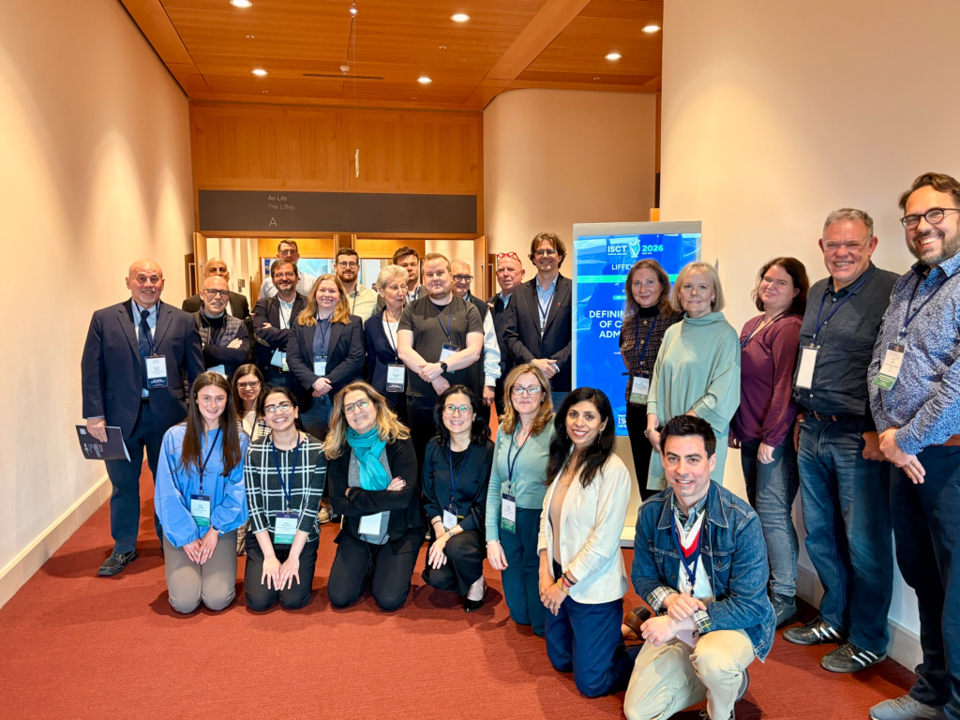
ISCT MSC Committee members and invited experts at the conference workshop, 'Defining the Fate of Clinically Administered MSCs', held during the ISCT Annual Meeting in Dublin on 5 May 2026. The workshop focused on developing shared experimental approaches to study MSC fate, apoptosis, extracellular vesicles and host immune responses after administration.
#CommunityFeature