
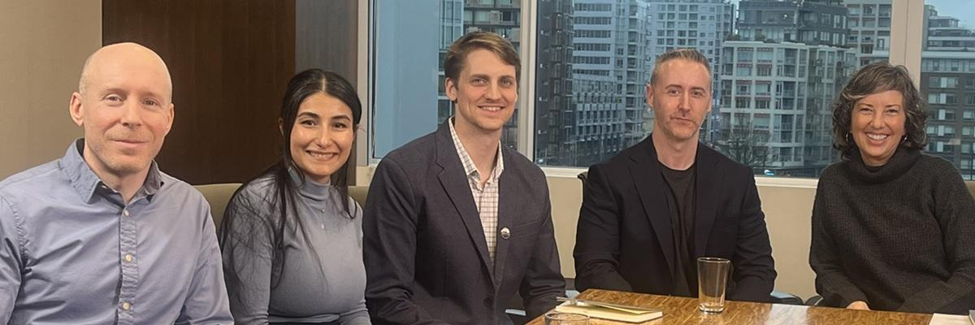
 Panelists from “Balancing Speed, Safety, and Scale in hPSC-Derived Therapy Development,” from left: Dr. Richard Carpenedo, Dr. Nika Shakiba, Dr. Ross Jones, Dr. Andrew Gaffney, and Lynn Csontos.
Human pluripotent stem cells (hPSCs) offer a renewable starting point for generating diverse, specialized cell types, making them an attractive platform for allogeneic cell therapy development. Yet the same biological plasticity that makes hPSCs so powerful can also complicate the translation of hPSC-derived cell therapies from early-stage research to safe, scalable, and clinically viable products. A differentiation protocol may generate cells with a promising phenotype at research scale. A reliable therapy, however, must do much more. It must begin with consistent starting material, guide cells through multiple developmental stages, generate sufficient numbers of functional cells, control unwanted variability, and meet evolving expectations for quality and safety. The process must also remain practical at a clinically relevant scale.
These challenges were discussed at length in a recent panel discussion hosted by STEMCELL Technologies, “Balancing Speed, Safety, and Scale in hPSC-Derived Therapy Development.” The panel brought together Dr. Richard Carpenedo, Lead Bioprocess Engineer at the Immune Cell Manufacturing Hub at the University of British Columbia (UBC); Dr. Nika Shakiba, Assistant Professor in the School of Biomedical Engineering at UBC; Dr. Ross Jones, a postdoctoral fellow in UBC’s Stem Cell Bioengineering Lab; Dr. Andrew Gaffney, Vice President of the iPSC Platform at STEMCELL Technologies; and Lynn Csontos, Vice President of Regulatory Affairs at STEMCELL Technologies. Across these different perspectives, one theme kept coming up: successful clinical translation is not solely a biology or manufacturing or regulatory problem. Decisions in each area, often from the earliest stages of development, shape the others. The following summary focuses on the parts of that wider conversation that dealt most directly with moving hPSC-derived cell therapies from the bench toward the clinic.
Translation Starts at the Bench
It can be tempting to treat translation as a challenge that begins after a differentiation protocol has been optimized. One of the panel’s strongest messages, however, was that early research decisions can determine whether a process can later be scaled and adapted to meet relevant regulatory requirements. Dr. Gaffney noted that choices made “at the bench” often become embedded in processes and are difficult to change later. A culture format, material, or process step that is convenient during discovery may create downstream challenges related to scale, consistency, documentation, or regulatory justification.
Dr. Carpenedo pointed to feeder cells as one example. Feeder-dependent methods may work well in research, but can add complexity when developers begin considering scalable and GMP-compliant manufacturing. Evaluating more defined alternatives early can reduce the risk of having to rebuild a successful process later. Dr. Jones pointed to synthetic biology as a potential strategy for designing a process with translation in mind. For example, genetic engineering is often considered in terms of the therapeutic function added to the final cell. It may also be possible to engineer cells in ways that improve differentiation, lineage specification, or process robustness. The “sweet spot,” according to Dr. Jones, may be one that supports both the eventual therapeutic function and the reliable production of the cell.
Dr. Shakiba described part of academia’s role as “future-proofing” emerging technologies: looking beyond the immediate experiment to anticipate the problems that may appear once early clinical studies begin to succeed. She acknowledged that this involves some “crystal ball” thinking. The point is not to predict every future problem, but to keep downstream constraints in view while decisions are still easier to change. Researchers should ask whether their materials can be sourced and documented, whether the process can move into a scalable platform, and whether critical steps can be measured and controlled. Early awareness can prevent a successful research protocol from becoming a translational dead end.
Define the Product (Without Defining It Too Rigidly)
A clear view of the intended product can keep development from becoming an endless optimization exercise. Dr. Gaffney emphasized the value of defining the characteristics required in the final product. Dr. Shakiba framed the related challenge as deciding what is “good enough.” Pursuing a theoretical “unicorn” product with every desirable attribute can consume resources without necessarily improving clinical value. Developers need evidence-based thresholds for identity, purity, function, safety, and manufacturing consistency, even as those thresholds continue to evolve.
While having a clear direction is important, Dr. Carpenedo cautioned against locking in the product definition too early. Initial development often proceeds with incomplete biological and clinical information. An intended product profile should guide decisions but remain flexible enough to change as new data emerge. Drs. Jones and Shakiba weighed in on how this thinking should also extend to intermediate populations. hPSC-derived products often pass through several developmental stages, with the output of one stage becoming the input for the next. A change that improves an upstream process could make a downstream process either better or worse. Conversely, a higher-quality intermediate may improve final differentiation without requiring the entire process to change. Defining meaningful attributes at each stage can help teams identify where an intervention is most likely to improve the final product.
Standardize What You Can, Then Study the Heterogeneity That Remains
A differentiation process can only be as consistent as its starting material. Establishing a well-characterized cell bank and standardized procedures for thawing, expanding, and preparing hPSCs is therefore foundational. Dr. Gaffney described broad categories used to evaluate undifferentiated hPSC banks, including viability and growth, testing for adventitious agents, genomic integrity, and confirmation of the undifferentiated and pluripotent state. This level of characterization helps researchers begin with cells that meet defined criteria and supports consistency across experiments and batches.
Standardization, however, does not mean biological uniformity. Dr. Shakiba described cell populations as “multicellular societies.” Cells that appear equivalent based on a few markers may still differ in gene expression, epigenetic state, signaling history, or interactions with neighboring cells. Some variation may be transient; other differences may have important effects on differentiation or function. Single-cell omics, lineage tracing, and synthetic biology tools may help reveal which forms of heterogeneity matter. By following cells over time, researchers can begin connecting an earlier molecular state with a later manufacturing or functional outcome.
Dr. Jones added that heterogeneity can also be useful. Deliberately introducing diversity can support screening experiments that reveal which genetic variants, cell states, or process conditions perform best. Knowledge gained through this reverse-engineering approach can then inform more precise forward engineering. The practical goal is not to assume that all variation can be eliminated. It is to standardize controllable inputs, identify meaningful sources of variability, and develop assays that distinguish harmless noise from changes that predict product performance or process failure.
Scale-Up Is Not Simply a Larger Research Protocol
Moving into a larger vessel can change mixing, mass transfer, shear, cell density, aggregate behavior, nutrient availability, and sampling. As a result, the scaled process may not reproduce the research protocol exactly and may generate a different cell product.
Dr. Carpenedo shared that developers often operate under constraints that require them to choose a scale-up platform without the time or resources to evaluate every option. He explained that thoroughly characterizing the research process can make that decision, and the subsequent move to a scaled process, more manageable. Thorough process characterization and an iterative Quality by Design approach, supported by appropriate Process Analytical Technology, can help teams define the Critical Quality Attributes they are trying to achieve at each stage and understand how process parameters contribute to those attributes. Because the resources available for troubleshooting at scale are finite, modeling and simulations can help teams prioritize what to test by generating hypotheses that can be evaluated experimentally.
Dr. Shakiba noted that cellular engineering still lacks the predictive simulation platforms available in fields such as electrical or mechanical engineering. Cell therapy developers are often trying to understand the system while building the manufacturing process around it. In her words, the field remains closer to “cellular tinkering” than fully predictive cellular engineering. Until better models are available, stage-specific characterization, carefully designed experiments, and intentional process perturbations will remain essential for understanding how a process behaves.
Lock a Baseline Process, Not the Learning
A process eventually needs to be sufficiently defined to support reproducible studies and manufacturing runs. However, that does not mean improvement must stop once a process is locked in. Dr. Carpenedo advocated maintaining a defined, end-to-end baseline process while investigating changes in parallel. The baseline provides a reproducible comparator. Proposed improvements can then be assessed based on whether they deliver a meaningfully better product. Intentional perturbation can be particularly valuable. Varying selected parameters within and beyond their anticipated operating ranges can reveal which deviations are tolerable, which measurements signal that the process is drifting, and when a run should be discontinued. Dr. Jones emphasized that this work is especially important for multistage differentiation. Improving one stage may leave the rest of the process intact, but it may also change how cells respond to downstream conditions. A better upstream intermediate does not automatically guarantee a better final product.
Ms. Csontos underscored the need to document every iteration. If an iteration “wins the lottery” and produces an unexpectedly strong result, details such as passage history, timing, material lot, handling, equipment, or deviations may be necessary to explain and reproduce it. A useful development strategy may therefore be to lock a particular process version for defined studies while continuing to learn in parallel. This provides the stability needed for comparison without assuming that the current version is final.
Treat Regulatory and Raw Material Strategy as Part of Process Design
Regulatory requirements are often perceived as rigid constraints on innovation. Ms. Csontos offered a different view, describing regulation in an emerging field as “a place of creativity.” Guidance is often broad because developers and regulators are still learning how best to assess these complex products. Rather than asking regulatory colleagues to prescribe one technically correct process, her advice was to start with the strongest technical solution and work with quality and regulatory experts to build a justification around it while always keeping the patient in mind.
Collaboration between developers, quality and regulatory teams, and suppliers should begin early, particularly when selecting and qualifying raw or ancillary materials. GMP-grade options may not exist for every component in an hPSC workflow. Developers are nevertheless expected to use the highest-quality materials available and understand the risks associated with them. Ms. Csontos summarized the appropriate mindset as “trust but verify.” A product label alone cannot replace material qualification. Even when a material carries a GMP or animal origin-free claim, developers may need to look beyond the label, gather documentation such as Certificates of Analysis and Certificates of Origin, and ask suppliers pointed questions about how the material was manufactured. For example, an animal origin-free product might contain a recombinant cytokine that was itself manufactured using an animal-derived component, illustrating the level of detail developers may need to understand when evaluating their materials. Early supplier engagement gives developers more time to surface documentation gaps, clarify material details, and build a working relationship that supports ongoing communication as regulatory feedback emerges. Raw material qualification is therefore not something to defer until later in development; addressing it early can help shape the development strategy as the process advances.
Safety Characterization and Engineering Must Evolve Together
Determining whether an hPSC-derived product is sufficiently safe remains one of the field’s most difficult challenges. Dr. Gaffney described how genomic integrity assessment has expanded over time, from detecting larger karyotypic abnormalities to examining point mutations in cancer-related genes such as TP53 and BCOR. He also observed growing interest in whole genome sequencing and noted that the U.S. Food and Drug Administration (FDA) has begun to welcome whole genome sequencing data in regulatory submissions. However, the volume of data generated can make analysis difficult. One way researchers are approaching this challenge is by checking identified mutations against resources such as the COSMIC database and Shibata’s list to determine whether they occur in known oncogenes or tumor suppressor genes. Dr. Gaffney suggested that this type of genomic assessment may become a more prominent part of regulatory submissions.
Dr. Shakiba raised a broader question: should the goal always be zero risk, or should these therapies be assessed through a risk-management framework similar to other medical interventions? Such an approach would require developers to characterize and reduce risk where feasible, while appropriately communicating remaining uncertainty. Engineered safeguards may become part of that strategy. Dr. Jones noted that a kill switch—an engineered safeguard designed to eliminate unwanted cells if needed—is only useful if it works robustly in the rare cell that may pose the greatest risk. Every additional genetic modification also adds complexity that must be justified and characterized. Dr. Shakiba suggested that future systems may use redundant or state-responsive safeguards; for example, eliminating cells that retain an unwanted pluripotent state beyond the appropriate process stage.
The same tension between new capabilities and new oversight questions surfaced in the discussion of artificial intelligence (AI) and machine learning. Dr. Gaffney suggested that these tools could become part of iterative manufacturing systems as the final product is developed. At the same time, embedding AI in a manufacturing process would raise questions about how well developers understand what the system is doing and how regulators will assess it.
Closing the Gap Requires Connecting the Pieces
When asked to identify the field’s greatest barrier, the panelists offered different but closely related answers. Dr. Jones described a persistent gap between the cells developers want to make and the cells they can currently produce. Dr. Carpenedo similarly pointed to the challenge of generating cells that approach the function of primary cells, and then doing so consistently at scale. Dr. Shakiba got to the root of the issue: “The barrier is biology.” Developers are engineering systems whose underlying rules are still being discovered.
Dr. Gaffney observed that it may be easier to demonstrate desired function than to establish safety, especially as the field collectively navigates the challenge of defining what “safe” means. Ms. Csontos added that this is an opportunity for the field to use the flexibility of the current regulatory environment to generate evidence and build shared knowledge.
Taken together, the panel’s discussion suggests that translation is not a sequence of handoffs. Decisions at the bench shape whether a process can be scaled; scale-up can change the cell product and the characterization it requires; and quality and regulatory considerations can, in turn, reshape process design. Successful translation depends on keeping biology, engineering, manufacturing, quality, and regulatory strategy connected throughout development.
Continue Building Your hPSC and Cell Therapy Expertise
This article captures only part of the wide-ranging conversation. Watch the on-demand webinar, “Balancing Speed, Safety, and Scale in hPSC-Derived Therapy Development,” to hear the panelists explore process lock-in, heterogeneity, genomic integrity, acceptable risk, AI-enabled manufacturing, engineered safeguards, and other questions in greater depth. If you’d like to explore related topics, access free, self-paced training courses from STEMCELL Technologies on Applying the ISSCR Standards for Research, Expansion of hPSCs in 3D Suspension Culture, and Ancillary Materials. These courses provide practical guidance on cell characterization and reporting, scalable hPSC workflows, and the qualification of materials for translational research.
About STEMCELL Technologies
Driven by science and a passion for quality, STEMCELL Technologies offers over 2500 tools and services to support discoveries in fields such as regenerative medicine, immunotherapy, and disease research. Whether you're culturing and editing hematopoietic stem and progenitor cells, differentiating pluripotent stem cells, or activating and expanding immune cells, we have the specialized cell isolation products, high-performance cell culture media, and accessory tools for your research. By increasing the accessibility of innovative techniques like gene editing and organoid cultures, we’re helping scientists accelerate the pace of discovery—so they can get therapies to patients faster. Researchers working towards clinical trials can also obtain guidance and customized support through our Services for Cell Therapy Program on qualifying our products for use as raw/ancillary materials. To learn more, visit www.STEMCELL.com.