Strategies for the Safe and Efficient Transport of Full Liquid Nitrogen Freezers
Monica Klein, MD
Associate Medical Director, Human Cellular Therapy Laboratory
Eric Gilles
Supervisor, Center for Regenerative Biotherapeutics
Is your lab planning to work with cryopreservation? Need a primer to get started? Hear about some proven practices in managing liquid nitrogen from the ISCT Lab Practices Committee. Included are key factors to consider including practical transportation practices, freezer model designs, and tools and tricks to keep items stable during movement.
Click Here To Access Presentation Deck View
Liquid and vapor phase nitrogen (LN2) freezers
- Long term storage of cellular therapy products are kept in liquid or vapor phase nitrogen freezers at -150 to -196 degrees Celsius.
- Extreme care must be taken during transport of freezers to ensure the fragile cryopreserved product bags remain intact and to prevent damage to the freezers.
Laboratory time and space challenges
- The long-term storage of cellular therapy products coupled with finite laboratory space and the large footprint of LN2 freezers make space a constant challenge in cellular therapy laboratories.
- One method to alleviate storage challenges is to transport LN2 freezers containing patient products to different storage locations.
- Given the irreplaceable nature of these products, extreme care must be taken to preserve the integrity of these products during transport.
Factors to consider prior to transport
- Liaison with Legal and Risk Management to obtain insurance coverage in case of damage calculated based on the cost of patient re-collection.
- Request internal construction/professional moving services to aid in transport.
- Map out the travel route and to avoid railroad tracks, potholes, uneven thresholds, etc.
- Arrange a police escort to aid during transport and consider time and day of travel, i.e., early mornings, avoid busy weekends, weather conditions.
- Have backup LN2 freezers at both locations.
- Arrange a moving truck with an air suspension system to reduce bumps and vibrations.
Consider LN2 freezers models
- Consider the LN2 freezer design:
- Standard LN2 freezers contain liquid nitrogen at the bottom of the freezer compartment that sits below the racking system.
- LN2-jacketed freezers separate the liquid nitrogen within the freezer walls and are not at risk of contact with the freezer contents.
- During transport, a standard freezer on a grade could shift the LN2 and contact the bottom of the racks. Avoid moving this type of freezer after a fresh fill as the LN2 level will be higher. Consider removing products from the very bottom of the racking system when moving tanks of this design.
Created in BioRender. Klein, M. (2025) https://BioRender.com/7u5vllv
Construction
- At Mayo Clinic Rochester, custom pallets were designed with a hard rubberized top surface and air dampened cushions on the bottom to secure LN2 freezers during transport.
- The elevated top surface also had a central space to fit the convex bottom of the LN2 freezer and to protect the wheels.
Planning your move
- Identify tank(s) to be moved.
- Consider age of products contained in tank.
- Consider ensuring selected tanks are as full as possible.
- Ensure all racks in tanks are secured within the racking system.
- Select LN2-jacketed models if possible to avoid liquid nitrogen splashing at bottom of tank.
- Monitor the temperature throughout transport.
- Use a slow speed of travel (5-8 mph) to reduce bumps.
- Do a practice run prior to moving patient products.
- Practice run LN2 freezers should contain mock patient products.
Securing LN2 freezers
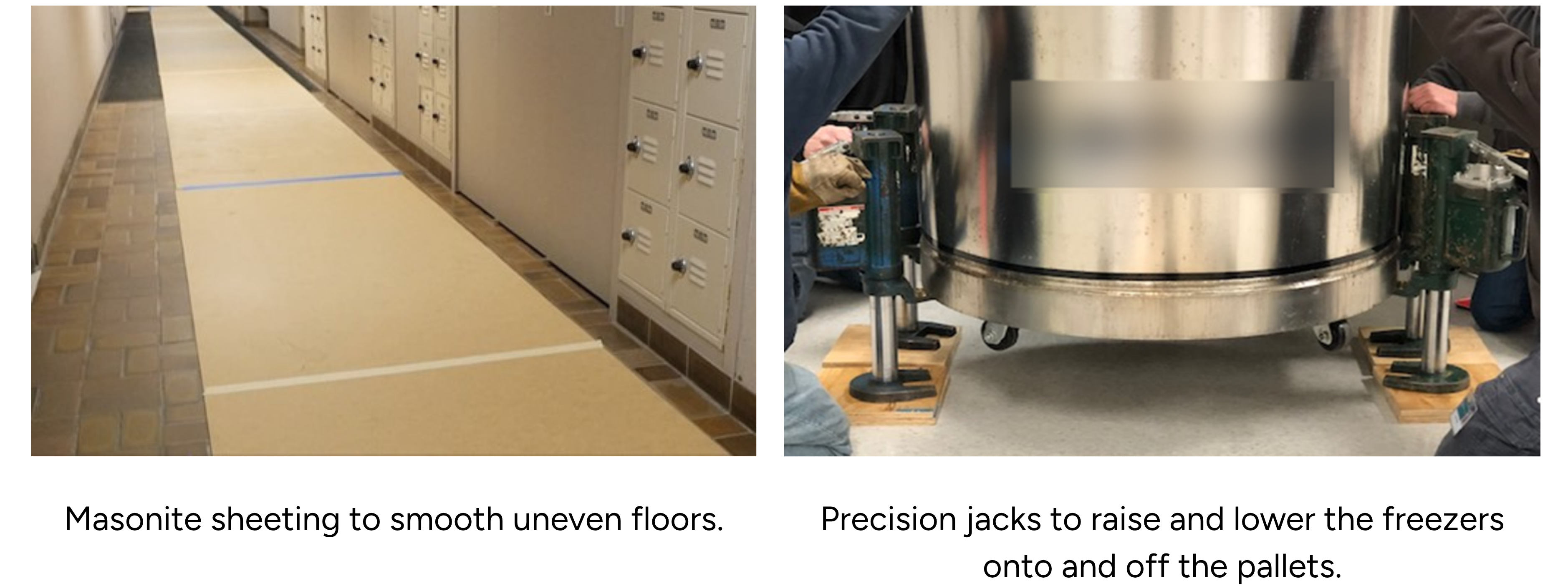
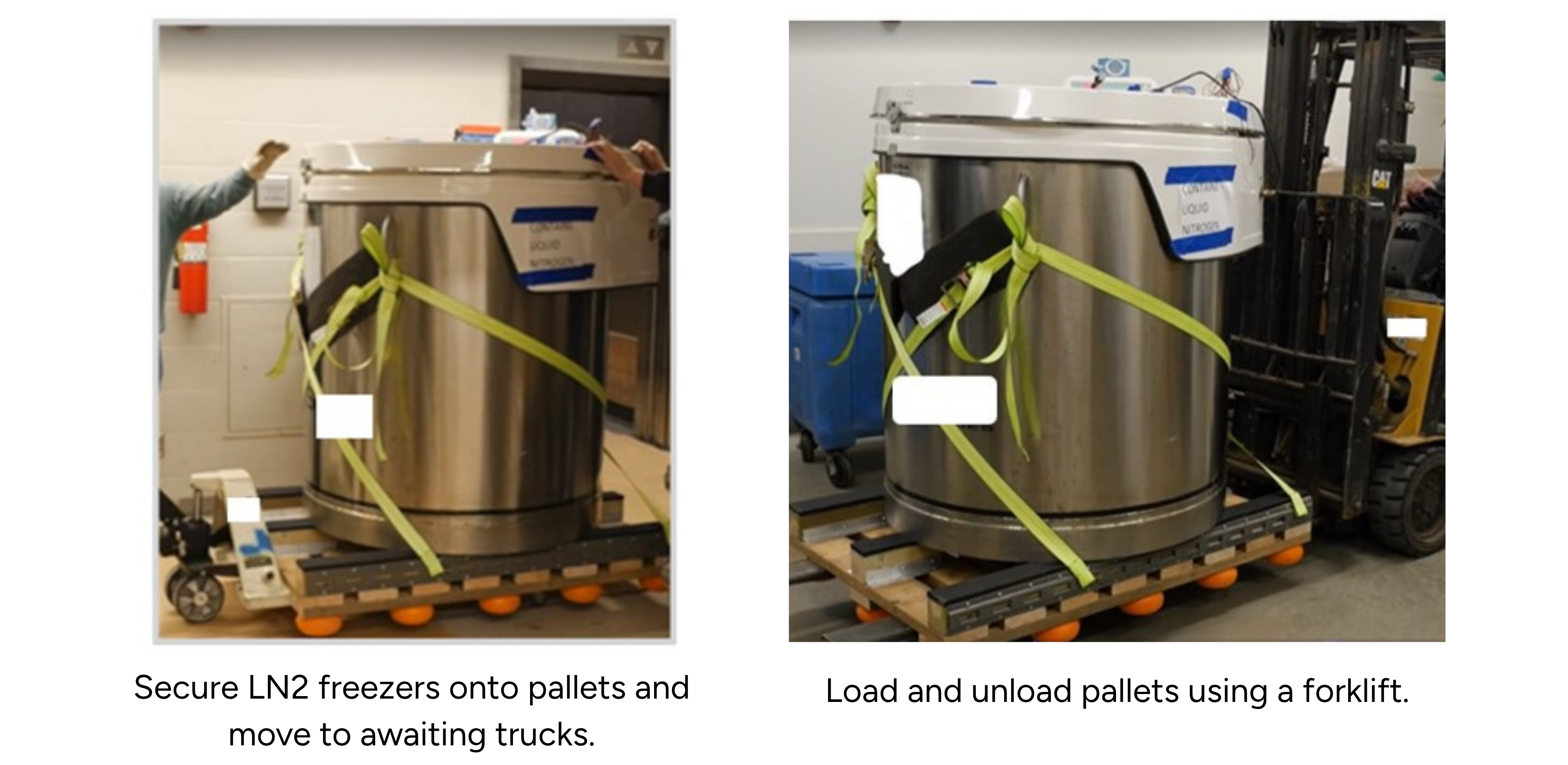
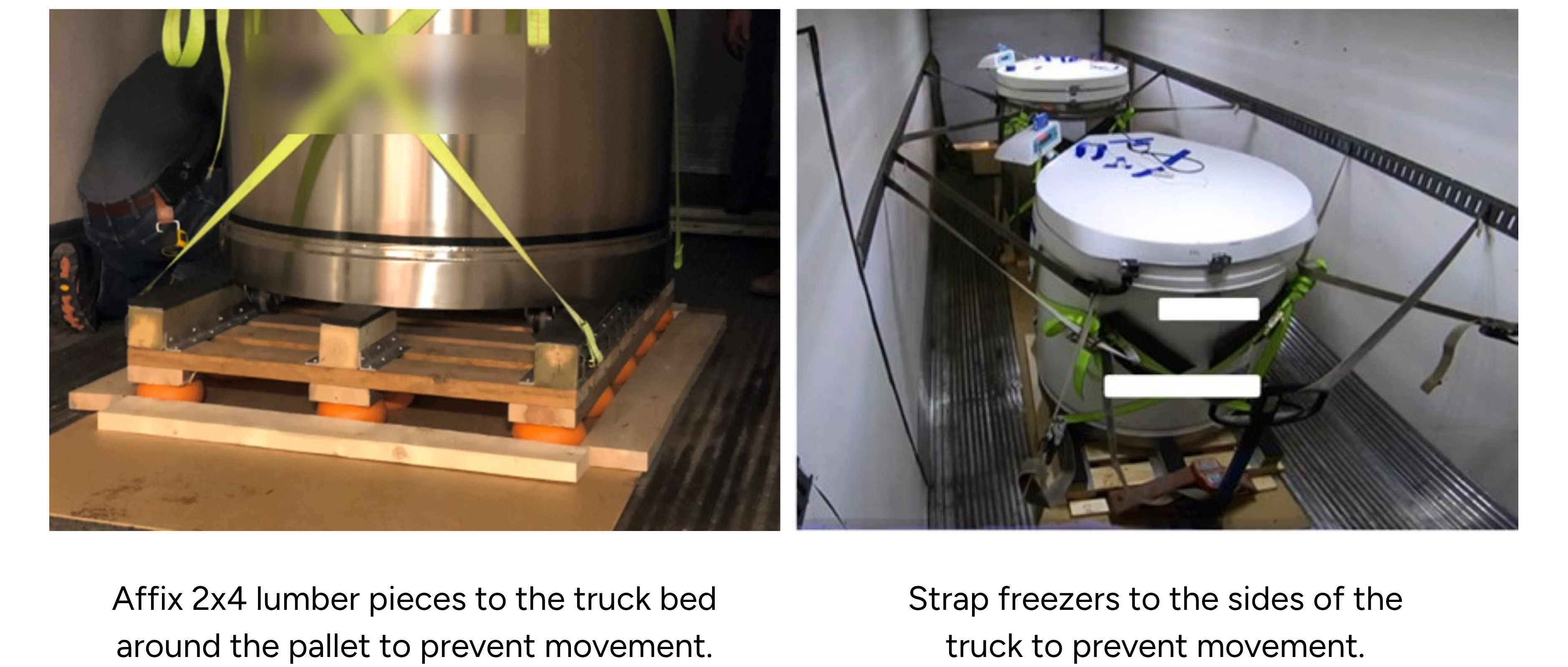
Transporting LN2 Freezers
Post mock LN2 freezer transfer
- Review the temperature data to ensure no excursions or erratic temperature shifts throughout the move process.
- Perform LN2 freezer re-validation.
- Thaw mock products to ensure product integrity.
- Following successful mock transfer, patient products can be transported safely and efficiently.
Acknowledgements
Special Thank You to:
- Eapen Jacob, MD, Medical Director, Human Cellular Therapy Laboratory
- Maggie DiGuardo, MD, Associate Medical Director, Human Cellular Therapy Laboratory
- Sarah Wittwer, Assistant Supervisor, Human Cellular Therapy Laboratory
#LPC
#LabPractices